Pla Vs Abs For 3d Printing - 3D printing has revolutionized the world we live in by providing an easy and affordable way to bring our wildest ideas to life. Whether you're a model enthusiast, an artist or just someone with a passion for creating, 3D printing has something to offer. However, not all filaments are created equal; two of the most popular filaments that are used widely today are PLA and ABS. PLA, an acronym for Polylactic Acid, is plant-based and biodegradable, while ABS, or Acrylonitrile Butadiene Styrene, is a petroleum-based thermoplastic.
PLA
Description
PLA has become one of the most commonly used materials in the 3D printing world due to its ease of use, precision, and versatility. It is made from renewable and non-toxic materials, and its biodegradable nature makes it an eco-friendly alternative to many other thermoplastics. PLA prints at a lower temperature than most thermoplastics, which makes it easier to work with.
Tips and Ideas
PLA is ideal for printing models and figurines, as well as functional household items. It can be used to print intricate shapes and designs with great accuracy and detail. PLA is available in a wide variety of colors, finishes, and densities, which makes it a popular choice for hobbyists and professionals alike. It is also cost-effective, easy to print with and can be used without a heated bed.
How to use PLA
When working with PLA, it is important to consider the environment in which your print will be placed as it is not heat resistant. When printing with PLA, make sure to print at a temperature between 185-220°C and to use a cooling fan to reduce warping. Also, keep in mind that PLA can be brittle, which means that it may break easier than other materials. Therefore, it is best to store PLA prints in a cool, dry place.

ABS
Description
ABS is a petroleum-based thermoplastic that is popular for its strength, durability and heat resistance. It is used in everything from automotive parts to kitchen appliances. ABS is commonly used in 3D printing because it can be easily smoothed and painted, resulting in a glossy finish. ABS prints at a higher temperature than PLA, which makes it more challenging to work with, but it also makes it more durable.
Tips and Ideas
ABS is ideal for functional parts that require more strength and durability such as automotive parts, electronics enclosures, and toys. It is also used in larger 3D prints because of its ability to hold its shape over time. ABS is available in a wide variety of colors, making it a popular choice for those who want to create colorful and functional prints. ABS is best printed on a heated bed, and it is recommended to use an enclosure to keep the temperature stable during printing.
How to use ABS
The process of printing with ABS is challenging but can be mastered with a few tips. It is recommended to print at a temperature between 220-270°C and to use an enclosure to keep the temperature stable. ABS is more prone to warping than PLA, so use a heated bed and a layer of glue or ABS slurry to help with adhesion. Lastly, it is important to let the print cool and slowly remove it from the bed to avoid cracking.

Post-processing PLA and ABS Prints
Vapour Smoothing PLA and ABS Prints
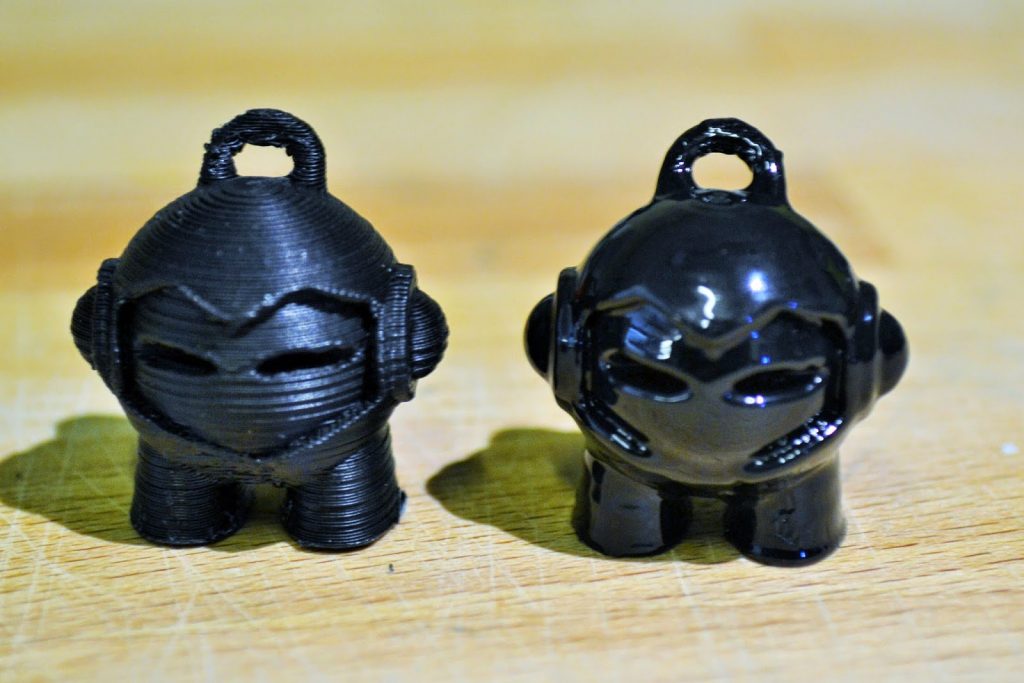
Vapour smoothing is a process that can be used to smooth out the surface of PLA and ABS prints, giving them a glossy finish. This process is done by exposing the print to acetone vapors, which melts the surface slightly, then evaporates to leave a smooth finish. The result is a glossy finish that is perfect for functional parts and models alike. However, this process is not recommended for prints that require more precision, as it can cause details to be lost or warped.
Sanding PLA and ABS Prints
Sanding is a process that can be used to smooth out the surface of PLA and ABS prints while preserving the detail. This process involves sanding the surface with progressively finer sandpaper until the desired level of smoothness is achieved. Sanding is ideal for prints that require a smooth surface but also retain the finer details of the print. However, sanding can be a time-consuming and messy process, making it less desirable for those who want to print quickly.
Painting PLA and ABS Prints
Painting is a process that can be used to add color and protection to PLA and ABS prints. This process involves painting the print with a primer, followed by acrylic or enamel paints, and then sealing the surface with a clear coat. This process is ideal for prints that require a decorative touch or protection from the environment. Painting is also a great way to cover up imperfections and mistakes, hiding them in plain sight.
Conclusion
PLA and ABS are two of the most widely used filaments for 3D printing. While PLA is biodegradable and easier to work with, ABS is more durable and has a glossy finish that makes it ideal for functional parts. Both filaments offer unique advantages and disadvantages, making them ideal for different types of projects. The post-processing techniques of vapor smoothing, sanding, and painting can be used to achieve a variety of finishes on prints. In the end, the choice between PLA and ABS depends on the preferences of the user and the specific requirements of the project.
Read more articles about Pla Vs Abs For 3d Printing