What Is Perspective In Art - Perspective in art refers to the technique that artists use to create the illusion of depth and spatial relationships on a two-dimensional surface. It involves the use of vanishing points, horizon lines, and various other methods to create the illusion of depth.
Awesome One-Point Perspective Art Collection
by Sci-Fi Design

Perspective is an essential tool for artists looking to create realistic, believable scenes in their work, and one-point perspective is one of the most basic and most important techniques to learn. This collection of one-point perspective art showcases the power and versatility of this technique, from stunningly detailed cityscapes to haunting dystopian landscapes.
One-Point Perspective City Streets
by Art with Mrs. Nguyen

One-point perspective is particularly well-suited to creating cityscapes, as it allows artists to create believable street scenes with convincing depth and scale. This tutorial from Art with Mrs. Nguyen provides a step-by-step guide to creating your own one-point perspective city streets.
One-Point Perspective Cityscape Drawings
by The smARTteacher Resource

If you're looking to practice your one-point perspective skills, this resource from The smARTteacher is a great place to start. With tips and tricks for getting the most out of your perspective drawings, as well as a downloadable worksheet to help you practice, this tutorial is perfect for artists of all levels.
Draw Perspective for Beginners
by Art Projects for Kids
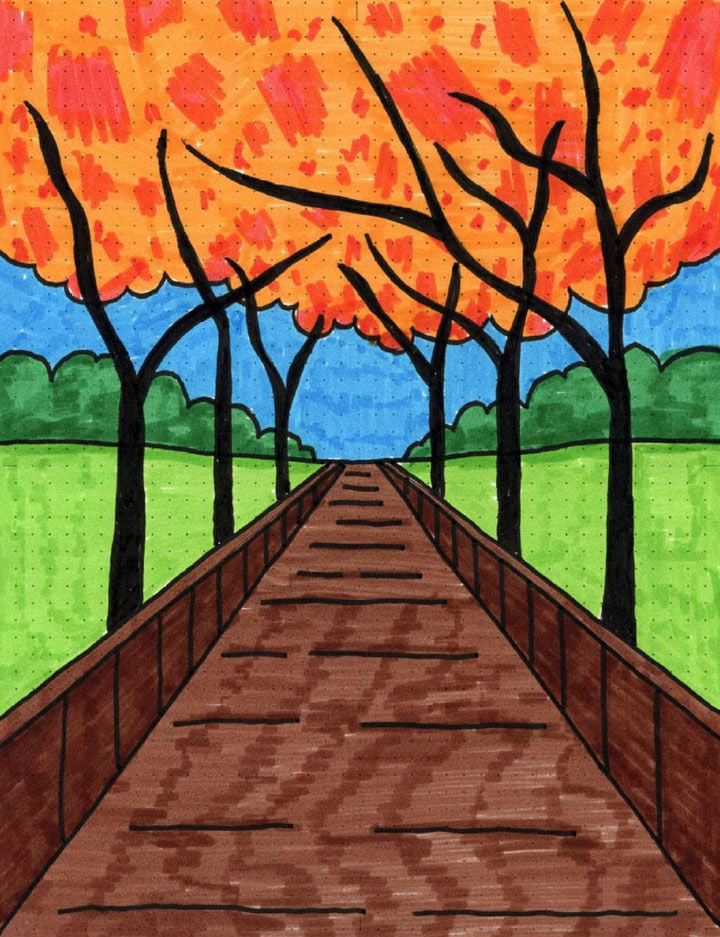
If you're new to perspective drawing, this tutorial from Art Projects for Kids is a great place to start. With clear, simple instructions and plenty of visuals to guide you along the way, this tutorial will help you master the basics of one-point perspective in no time.
One-Point Perspective Streetscapes 2.0
by Art with Mrs. Nguyen

For artists looking to take their one-point perspective skills to the next level, this tutorial from Art with Mrs. Nguyen offers a more advanced look at the technique. With tips for adding detail and texture to your streetscapes, as well as examples to guide you, this tutorial is perfect for artists looking to push their skills further.
Tips for Mastering One-Point Perspective
If you're looking to improve your one-point perspective skills, here are a few tips to keep in mind:
- Start simple: Don't try to tackle complex scenes right away. Start with simple shapes and work your way up.
- Use a vanishing point: The vanishing point is the key to one-point perspective. Make sure you have one in your scene.
- Draw lightly: One-point perspective requires a lot of erasing and adjusting, so draw lightly to make this process easier.
- Study the work of others: Look at the work of other artists who are skilled in one-point perspective to see how they use the technique.
- Practice, practice, practice: Like any skill, one-point perspective takes practice to master. Keep at it and don't get discouraged!
Ideas for Using One-Point Perspective in Your Art
Here are a few ideas for using one-point perspective in your artwork:
- Create a cityscape: Use one-point perspective to create a convincing cityscape, complete with buildings, streets, and people.
- Add depth to a landscape: Use one-point perspective to add depth and scale to a landscape, such as a mountain range or a forest.
- Create a surreal scene: Use one-point perspective to create a surreal, dream-like scene with impossible angles and shapes.
- Add drama to a portrait: Use one-point perspective to add drama and tension to a portrait, perhaps by positioning the subject at an angle or against a skewed background.
How to Use One-Point Perspective in Digital Art
One-point perspective isn't just for traditional drawing and painting. It can also be used in digital art, such as graphic design and 3D modeling. Here are a few tips for using one-point perspective in digital art:
- Use a grid: Many digital art programs have a built-in grid that you can use to create your scene with one-point perspective.
- Use layers: When working in digital art, it can be helpful to work on different layers so that you can adjust and edit your artwork more easily.
- Experiment with lighting: In digital art, you have more control over lighting than you do in traditional art. Experiment with different light sources to create different moods and atmospheres.
With these tips and ideas, you'll be well on your way to mastering one-point perspective and using it to create stunning, believable artwork!
Read more articles about What Is Perspective In Art